PulseSearch — real-time
CDC search + RAG
An AI-native search system over a live data firehose: change data capture streams every
write from MySQL into Elasticsearch, served as hybrid keyword + vector search and a grounded
RAG assistant via Groq (free tier). The full pipeline runs on
docker compose up; the app tier also ships as Kubernetes
manifests with probes and Ingress, and GitHub Actions lint, test, scan, and
publish images to GHCR — embeddings stay local, no paid cloud services.
The problem
Most "AI search" demos are thin wrappers on a static index. Real products aren't.
In production, the data never stops moving and the index has to keep up: writes land in a database of record, and search has to reflect them within seconds — not overnight — while staying consistent under retries, restarts and out-of-order delivery. On top of that, users increasingly expect semantic relevance and a question-answering assistant that is grounded in the freshest data, not hallucinated.
I wanted to build the whole spine of that system end to end — streaming ingestion, CDC, relevance engineering, real-time fan-out and retrieval-augmented generation — as one coherent, observable pipeline, and prove it with metrics rather than adjectives.
The approach
PulseSearch treats MySQL as the system of record and streams every row change into Elasticsearch, then serves both hybrid search and grounded RAG over that live index. It ingests a real firehose — Wikipedia's live edit stream — so the pipeline is genuinely continuous rather than a seeded demo.
- CDC, not polling — Debezium tails the MySQL binlog and publishes ordered change events to Kafka (Redpanda); a worker embeds each change and upserts it into Elasticsearch. Wikipedia summary enrichment runs async after indexing, so it doesn't inflate commit→searchable latency.
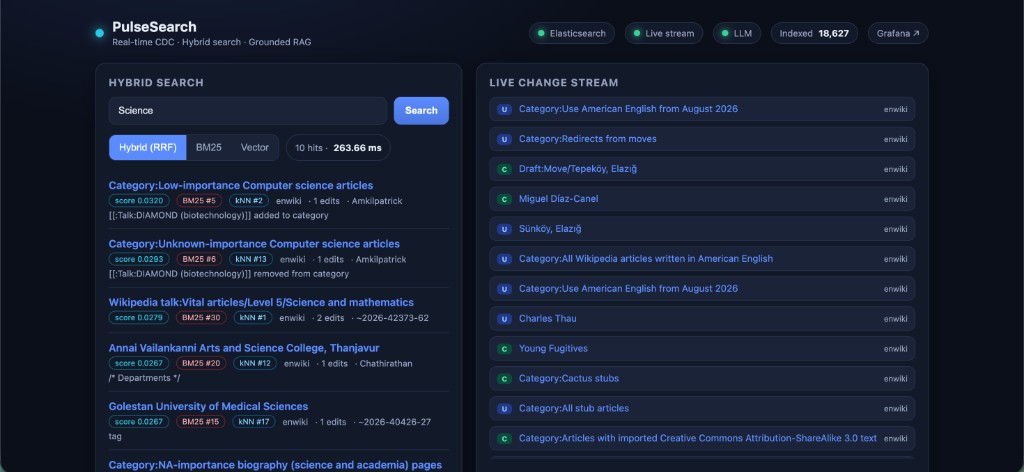
- Hybrid retrieval with RRF — BM25 and dense-vector kNN result lists are fused in application code with Reciprocal Rank Fusion, keeping it free of paid Elastic tiers and making ranking explicit and tunable. A labeled live eval script keeps relevance measurable.
- Grounded RAG — Groq's free-tier LLM (
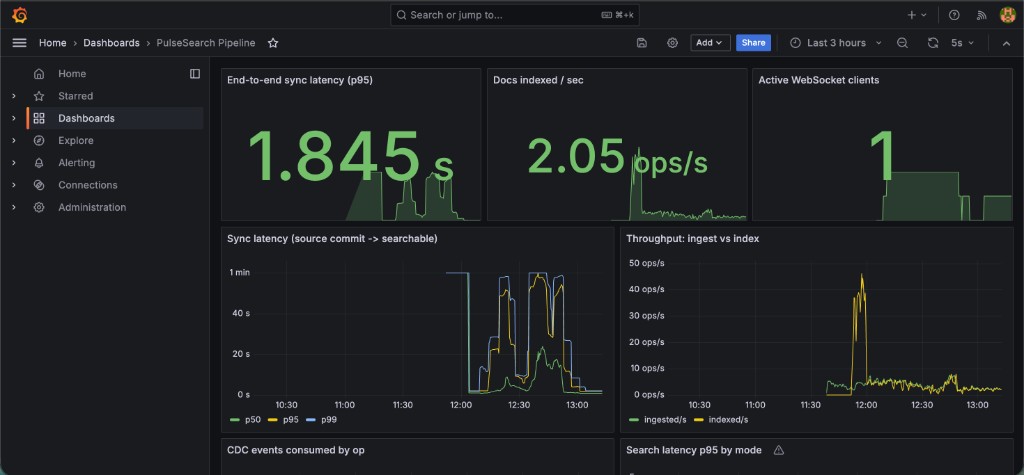
llama-3.1-8b-instant) answers strictly from retrieved context, cites sources with timestamps, reports the freshest source, and refuses when retrieval is empty — with an extractive fallback if the API is unavailable. - Observable by design — end-to-end "commit → searchable" latency, throughput, and DLQ rate are Prometheus metrics surfaced as p50/p95/p99 in Grafana.
- Ship the ops story too — Compose stays the one-command data-plane demo; the app services (ingest, worker, api, web) also run on Kubernetes with readiness/liveness probes, a ServiceAccount, and Ingress. CI runs Ruff, Bandit, unit tests, an Elasticsearch upsert→BM25 smoke, web lint/build, and kubeconform, then publishes images to GHCR on
main.
Architecture
One spine from firehose to searchable; Kafka also drives the live dashboard, and FastAPI serves hybrid search + grounded RAG.
In action
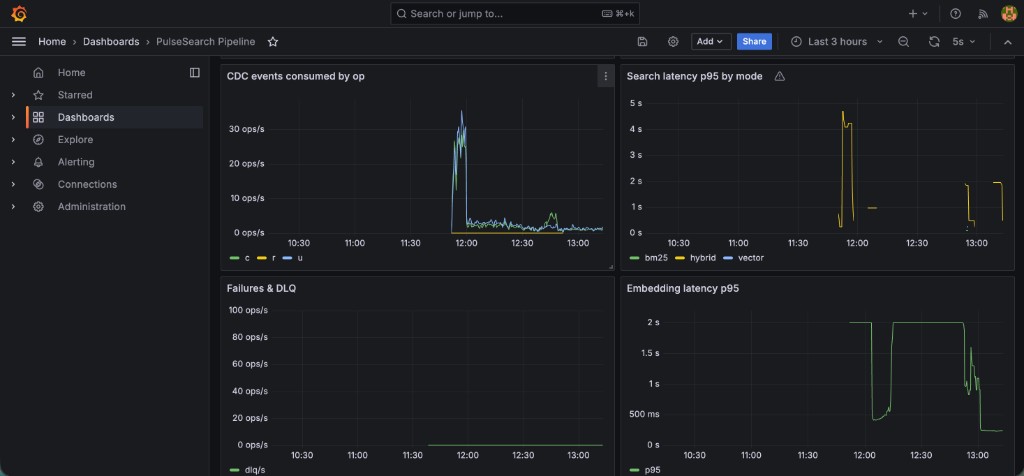
Screenshots from a live local run — the product UI recruiters can relate to, plus the Grafana panels that make the pipeline's SLOs and failure modes observable rather than asserted.
The hard parts
Effectively-once indexing on at-least-once delivery
Kafka offsets are committed only after a batch is durably written to Elasticsearch. Upserts are
version-guarded using Debezium's ts_ms as an external monotonic
version (version_type=external_gte), so replays and out-of-order delivery can never
regress a document to an older state.
Replayable backfill & poison-message isolation
Because the change history lives in Kafka, rebuilding the index is a replay from the log, not a database-crushing reindex. Unparseable or repeatedly failing messages are routed to a dead-letter topic instead of wedging the whole stream.
Ranking that's free and explicit
Native RRF retrievers require a paid Elastic tier, so I fuse BM25 and kNN result lists in code
(k = 60). Every hit exposes its BM25 and kNN ranks, making relevance transparent and
tunable rather than a black box.
Keeping the CDC path fast
Wikipedia page summaries are useful for search and RAG, but fetching them on the critical path inflated sync latency. Enrichment now runs after the document is searchable, so commit→index stays lean while summaries still land asynchronously.
Grounding the assistant
The RAG endpoint answers only from retrieved context, cites sources with timestamps, reports the
freshest source, and returns grounded: false when retrieval is empty. Generation uses
Groq (llama-3.1-8b-instant, free tier) behind an LLMClient
protocol — with an extractive fallback if the API is unavailable, so the endpoint stays demonstrable.
Engineering
The codebase is deliberately layered and dependency-inverted so every concern is swappable and
testable: a shared kernel for config / models / embeddings / the ES repository / metrics;
Strategy interfaces behind Protocols for firehose sources, embeddings
and the LLM client; a Repository layer that keeps SQL and query DSL out of business
logic; and an anti-corruption layer that translates Debezium envelopes into clean
domain events. Unit suites cover the shared kernel, the Debezium adapter and the RRF fusion logic
with no external services required; CI also runs a live Elasticsearch smoke (upsert → BM25 find)
plus Ruff and Bandit on every PR.
CI/CD & Kubernetes
Recruiters ask for delivery, not only demos. PulseSearch wires that in:
- GitHub Actions — Ruff lint/format, Bandit (medium+), pip-audit (advisory), unit tests, ES smoke, Next.js lint/build, kustomize + kubeconform, then Docker Buildx for api / worker / ingest / web.
- CD on
main— the same images publish toghcr.io/shubhamsinha1010/pulsesearch-cdc-rag/{api,worker,ingest,web}tagged:latestand:sha-<short>. - Kubernetes app tier — Deployments with resource limits, HTTP readiness/liveness (API uses
/health/ready→ 503 when ES is down; workers probe/metrics), a non-automounting ServiceAccount, and host-based Ingress (pulsesearch.local/api.pulsesearch.local). A GHCR kustomize overlay points at the published images.
Outcome
Measured on a local Docker/Colima laptop demo (~38k Wikipedia change docs) — not cloud prod. BM25-only search is much cheaper (p50 ~27 ms); hybrid cost is mostly query embedding.